Cattle Vaccination Schedule: A Complete Year-Round Guide for Dairy Farmers
I have been a veterinarian long enough to notice a pattern. The farmers who call me the least are not the luckiest ones — they are the ones with a vaccination notebook. The farmers who call me the most are the ones who vaccinate “when they remember,” which usually means after animals start dying.
Here is a truth about dairy farming that took me years to fully appreciate: prevention is not just cheaper than treatment, it is the only strategy that actually works against diseases like gal ghotu (HS), foot-and-mouth disease, and black quarter. You cannot out-treat an outbreak. You can only out-vaccinate it.
This guide gives you a complete, practical vaccination calendar for cattle and buffaloes, built for real farms in Pakistan and India — not a textbook, but what I actually tell farmers standing in their barns.
Why Vaccination Beats Treatment Every Time
Let me make the economic case first, because that is what convinces most people:
- A single HS vaccine dose costs less than a cup of tea. Treating one HS case — if the animal even survives — costs hundreds of times more, and you usually lose the animal anyway.
- FMD does not usually kill adults, but one outbreak can erase two months of milk income from your whole herd.
- Black quarter kills young, healthy, fast-growing animals — exactly the ones you were counting on as your future milkers. It kills in hours, with almost no warning.
Vaccines do not just protect individual animals. When a whole village vaccinates, the diseases have nowhere to go — this is herd immunity, and it is how entire countries have eliminated some of these diseases.
The Core Vaccines Every Dairy Farm Needs
There are five diseases I consider non-negotiable for vaccination. Everything else depends on your area and your vet’s advice.
1. Hemorrhagic Septicemia (HS / Gal Ghotu)
- First dose: 4–6 months of age
- Booster: 2–3 weeks after the first dose
- Repeat: once a year, in May–June, before the monsoon
2. Foot-and-Mouth Disease (FMD)
- First dose: 4 months of age
- Booster: 1 month after the first dose
- Repeat: every 6 months (spring and autumn)
3. Black Quarter (BQ / Langra Bukhar)
- First dose: 6 months of age
- Repeat: once a year, before the rainy season
- Especially important for young cattle and buffaloes between 6 months and 2 years — that is BQ’s favourite age group
4. Anthrax
- First dose: 4–6 months of age in endemic areas
- Repeat: once a year
- Ask your veterinary officer whether anthrax occurs in your district. If it does, do not skip this one — anthrax kills fast and the carcass must never be opened.
5. Brucellosis
- Calfhood vaccination for female calves, usually between 4–8 months (single dose, strain 19 or RB51 depending on local availability and policy)
- This one is different: it is given once, only to young females, and it protects against abortion storms and helps control a disease that also infects humans
Your local veterinary department may add others — in some areas, theileriosis or IBR vaccines are recommended. Always check with your vet about what circulates locally.
The Year-Round Vaccination Calendar
Here is how I suggest mapping it across the year. Adjust by a few weeks for your local climate, but keep the order:
January–February (winter) — FMD booster round (the second of the two annual doses) for the whole herd. Review your records: which animals missed doses last year?
March–April (spring) — Brucellosis calfhood vaccination for eligible female calves. Deworming round (pairs well with vaccination season — but give them a week apart, not on the same day).
May–June (pre-monsoon — the most important window) — HS annual vaccination for the whole herd — do not enter the monsoon without this. Black Quarter annual vaccination, especially young stock. Anthrax annual dose in endemic areas.
July–August (monsoon) — Avoid routine vaccination during peak rains and heavy stress — vaccinate before, not during. Watch for disease outbreaks; this is surveillance season.
September–October (autumn) — FMD round for the whole herd (timed before the winter trading and movement season). First FMD doses for calves born in spring (now 4+ months old).
November–December — Catch-up: any animal that missed a dose. Plan next year’s purchases — vaccine, ice boxes, syringes.
One rule I never bend: never vaccinate the whole herd on the day of a wedding, a market trip, or any big stress event. Vaccination is mild stress. Stack it on top of transport or heat stress and you get poor immunity — or a reaction you will blame on the vaccine.
The Cold Chain: Where Good Vaccines Go to Die
I am going to say something blunt: half the “vaccine failures” I investigate are actually cold chain failures. The vaccine was fine when it left the factory. It died in somebody’s pocket, on a sunny shop shelf, or in a fridge that gets opened fifty times a day.
Vaccines are living (or delicately preserved) biological products. Heat kills them. Here is how to keep them alive:
- Buy from a reliable source — government veterinary hospitals and reputable distributors, not the shop with vials sitting in the window
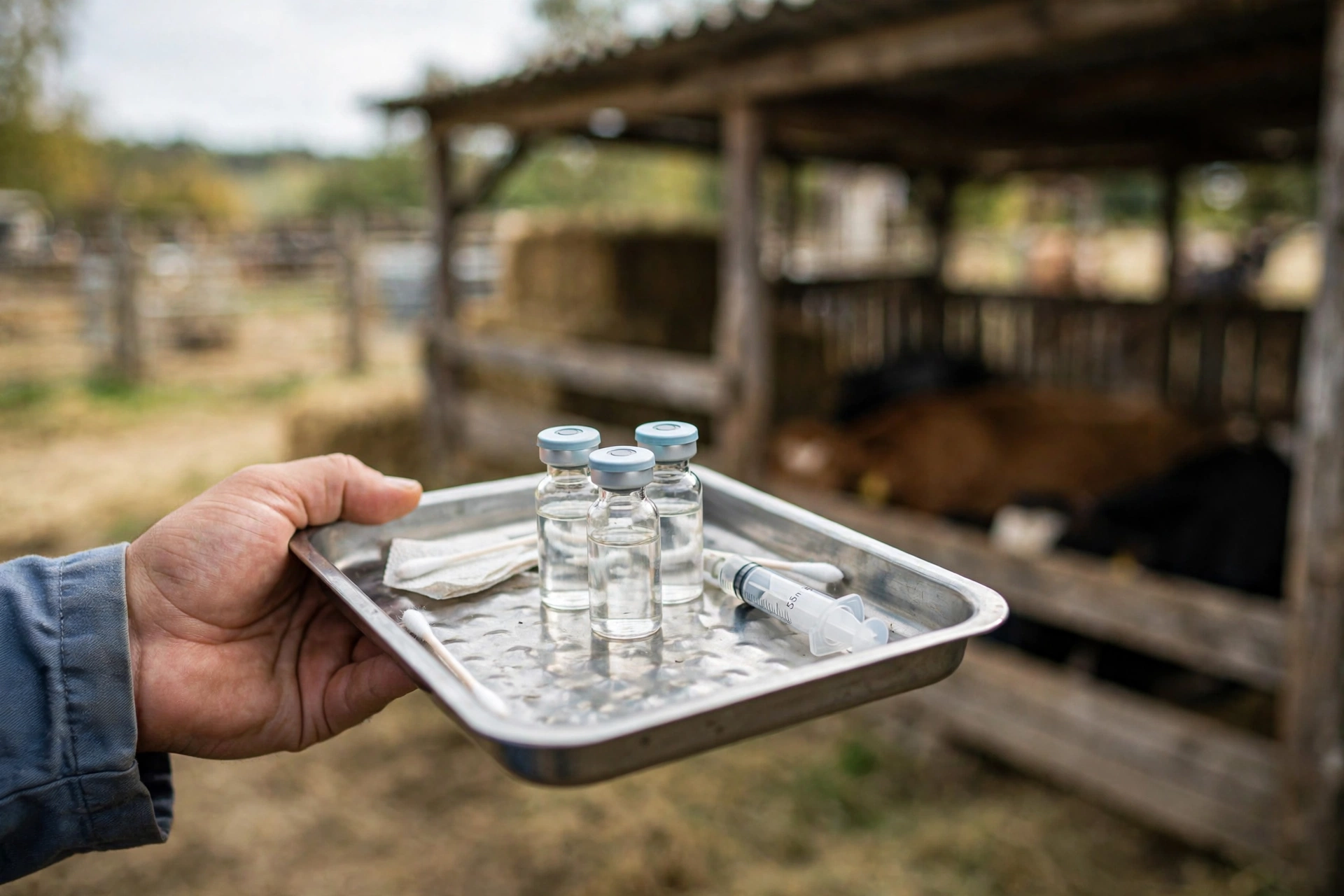
- Carry an ice box. Not a plastic bag — an actual insulated box with ice packs. It costs little and saves everything
- Use the vaccine the same day you buy it. Do not “save half the vial for next month”
- Keep it out of sunlight at every step — sunlight destroys some vaccines in minutes
- Do not freeze vaccines that should only be chilled (most bacterial vaccines). Freezing is as deadly as heat
- Shake gently, never vigorously, and check the expiry date before you pay
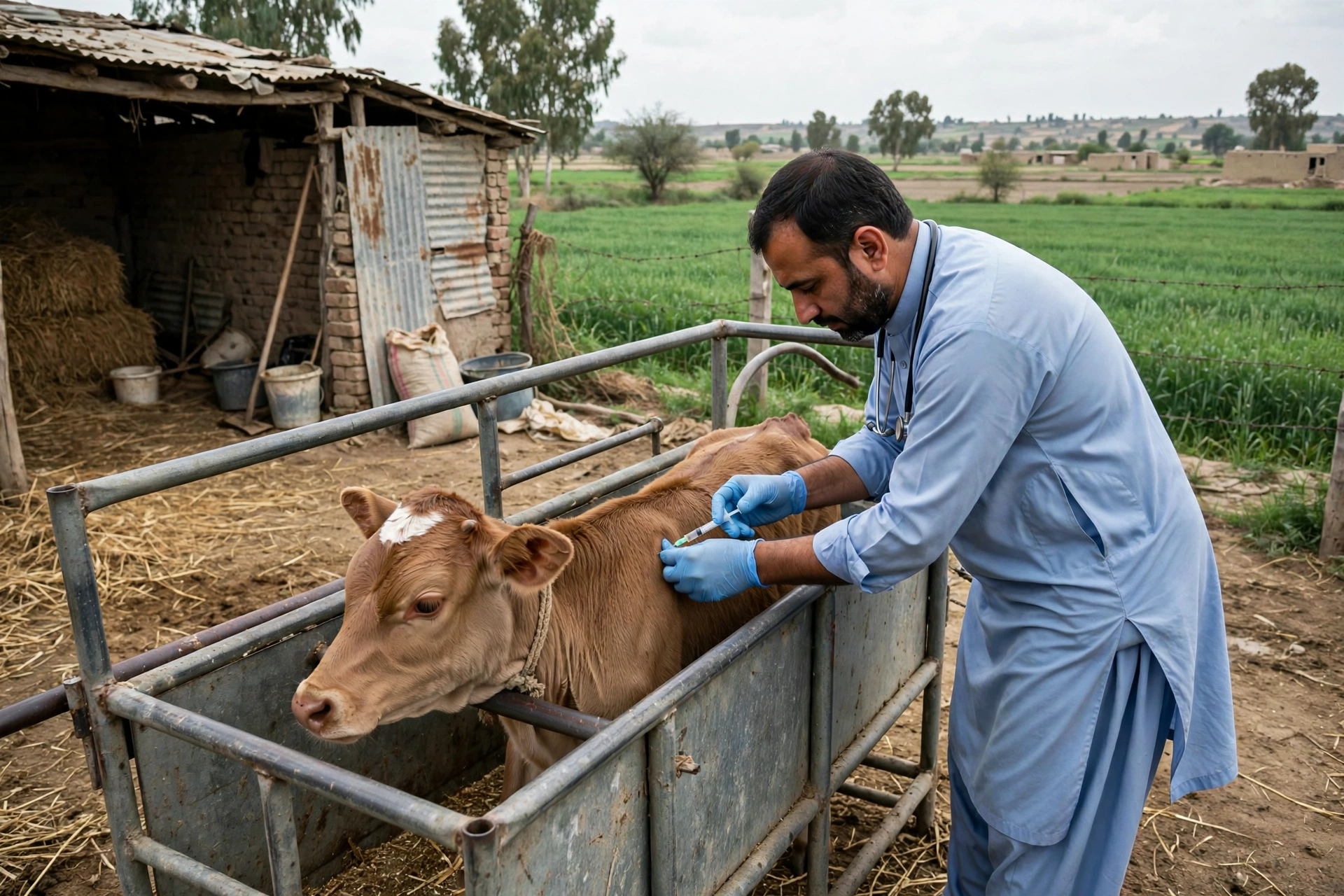
If you are hiring a vet or paravet to vaccinate, watch how they carry the vaccine. If it arrives warm in a shirt pocket, you are paying for coloured water. A professional brings a cold box — every time.
Vaccinating Correctly: Technique Matters
- Right route: Most cattle vaccines go under the skin (subcutaneous) in the neck region, or into the muscle (intramuscular) — the label says which. Wrong route means poor protection.
- Sterile needle per animal — or at minimum, change needles frequently. One dirty needle can carry infection through your whole herd.
- Correct dose: The full labelled dose for every animal. Splitting one dose between two animals to “save money” leaves both unprotected. This is the falsest economy in farming.
- Do not vaccinate sick animals. Wait until they recover. A sick animal’s immune system cannot build proper protection, and you will blame the vaccine for the disease it already had.
- Note pregnancy status. Most routine vaccines (HS, FMD, BQ) are considered safe in pregnancy, but always tell the person vaccinating — timing around late pregnancy deserves care.
Record Keeping: The Notebook That Pays for Itself
I mentioned the vaccination notebook at the start. Here is what goes in it — one line per animal per vaccine:
- Animal name or tag number
- Vaccine name
- Date given
- Next due date
- Who gave it
That is it. Five columns. And yet this little notebook is the difference between a protected herd and a hopeful one. When FMD hits the neighbouring village, you will know in thirty seconds whether your herd is covered or exposed.
If writing feels like a chore, even a phone note or a photo of each vaccinated animal with the date works. The format does not matter. The habit does.
Common Vaccination Mistakes I See
- Skipping the booster. The first dose primes the immune system; the booster is what actually builds lasting protection. A single dose without its booster is a half-built wall.
- Stretching the interval. “Six-monthly” FMD vaccination done every nine months is not six-monthly vaccination. Set phone reminders.
- Vaccinating during an outbreak and expecting instant protection. Immunity takes 2–3 weeks to develop. Emergency vaccination still helps the herd long-term, but it will not save animals already incubating the disease.
- Only vaccinating the milking animals. Young stock and dry animals are part of the herd’s disease pool. An unvaccinated calf can bring FMD into your vaccinated milkers’ shed.
- Mixing vaccines in one syringe to save time. Never. Different vaccines, different syringes, different injection sites.
Frequently Asked Questions
Can I vaccinate and deworm on the same day? It is better to space them about a week apart. Both are mild stresses on the immune system, and you want the full benefit of each. If you must do them close together, ask your vet — but a week’s gap is the standard advice I give.
My animal had a swelling at the injection site. Is the vaccine bad? A small, painless lump at the injection site for a few days is a normal reaction to some vaccines (especially HS and BQ) and usually resolves on its own. But a large, hot, painful swelling, or an animal that goes off feed with high fever after vaccination, deserves a vet’s look.
Is the free government vaccine as effective as the expensive private one? For the standard diseases — HS, FMD, BQ — government vaccines in Pakistan and India are produced to proper standards and work well when the cold chain is maintained. A free vaccine given on time protects better than an expensive one given late or stored badly.
What if I bought an animal and don’t know its vaccination history? Treat it as unvaccinated. Quarantine it for 2–3 weeks, then start the full schedule including boosters. It is the only safe assumption.
The Bottom Line
A vaccination program is not an expense. It is the highest-return investment on a dairy farm — a few hundred rupees a year per animal standing between you and diseases that can wipe out months of income overnight.
Get the notebook. Mark May and October on it. Keep the cold chain. And the next time disease sweeps through your area, you will be the farmer everyone else wishes they had listened to.
Disclaimer: This article is for educational purposes only and is not a substitute for professional veterinary advice. Vaccine schedules may vary by region — always confirm with your local veterinarian or livestock department.