Dairy Shed Design for Hot Climates: Ventilation, Flooring and Space
Ask most farmers what limits their milk production, and they will say feed, or breed, or disease. Very few mention the shed. But in my years of practice, I have walked into countless farms where the animals were well-fed and well-bred — and still giving two litres less per day than they should have. The common factor was almost always the housing: a low, dark, airless shed that turned into an oven by noon.
A buffalo standing in a hot, poorly ventilated shed is an animal under stress. And a stressed animal does not milk well. It eats less, drinks less, and spends its energy panting instead of producing milk. Research and field experience both agree: good housing in hot climates can protect 10–20% of your milk yield. On a ten-animal farm, that is the difference between a comfortable profit and a struggle.
Let me show you what actually matters in shed design for our climate — and what you can skip.
Why Shed Design Affects Milk Yield
It comes down to one thing: heat. Buffaloes are especially sensitive to it. Their dark skin absorbs heat, and they have fewer sweat glands than you might expect. When the temperature-humidity index climbs above the comfort zone — which in our region happens from April through September — the animal’s body diverts energy from milk production to cooling itself.
You can see it happening. Feed intake drops. The animal stands rather than lies down (lying down traps body heat against the ground). Milk falls by 1–3 litres per day per animal. Fertility suffers too — heat detection becomes harder because heat-stressed animals show weaker signs.
No amount of expensive feed fully compensates for an animal that is too hot to eat it. The shed is not a luxury; it is part of the feeding system.
Orientation: Which Way Should Your Shed Face?
This costs nothing to get right and a lot to fix later. In the northern hemisphere, the long axis of the shed should run east to west. This way, the low morning and evening sun hits the short ends, while the long sides stay shaded through the hottest midday hours.
I have seen sheds built north-south because “the plot was that shape,” and the animals inside spend every afternoon with direct sun pouring in one side. If your plot forces a north-south orientation, you will need deeper roof overhangs and possibly a shade net on the sun-facing side — so factor that in.
Roof Height and Roofing Material
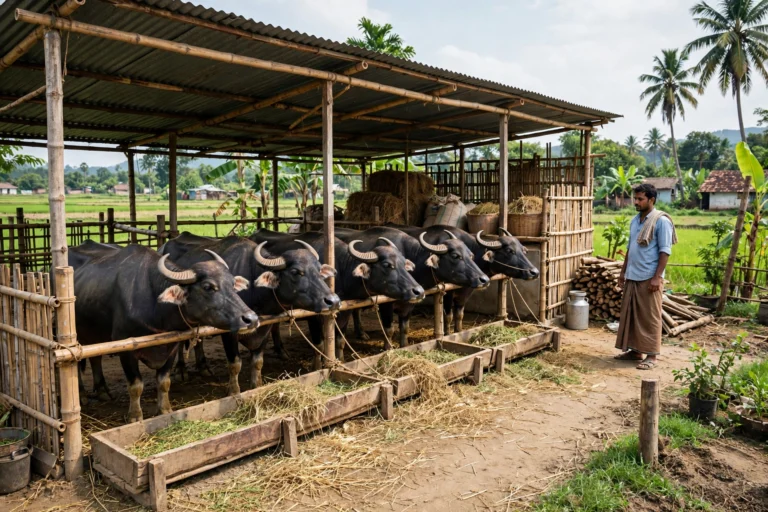
This is where most traditional sheds fail. A roof that sits 7–8 feet above the animals traps a layer of hot air right where the buffaloes breathe. Raise your roof to at least 10–12 feet at the eaves, higher at the ridge. Hot air rises; a high roof gives it somewhere to go instead of sitting on your animals.
For roofing material, you have options:
- Asbestos/cement sheets: Cheap and common, but they radiate heat downward. If you use them, painting the top white or covering with a reflective sheet makes a noticeable difference.
- Corrugated metal (tin): Worse than asbestos for heat — it turns the shed into a furnace. Avoid it unless insulated.
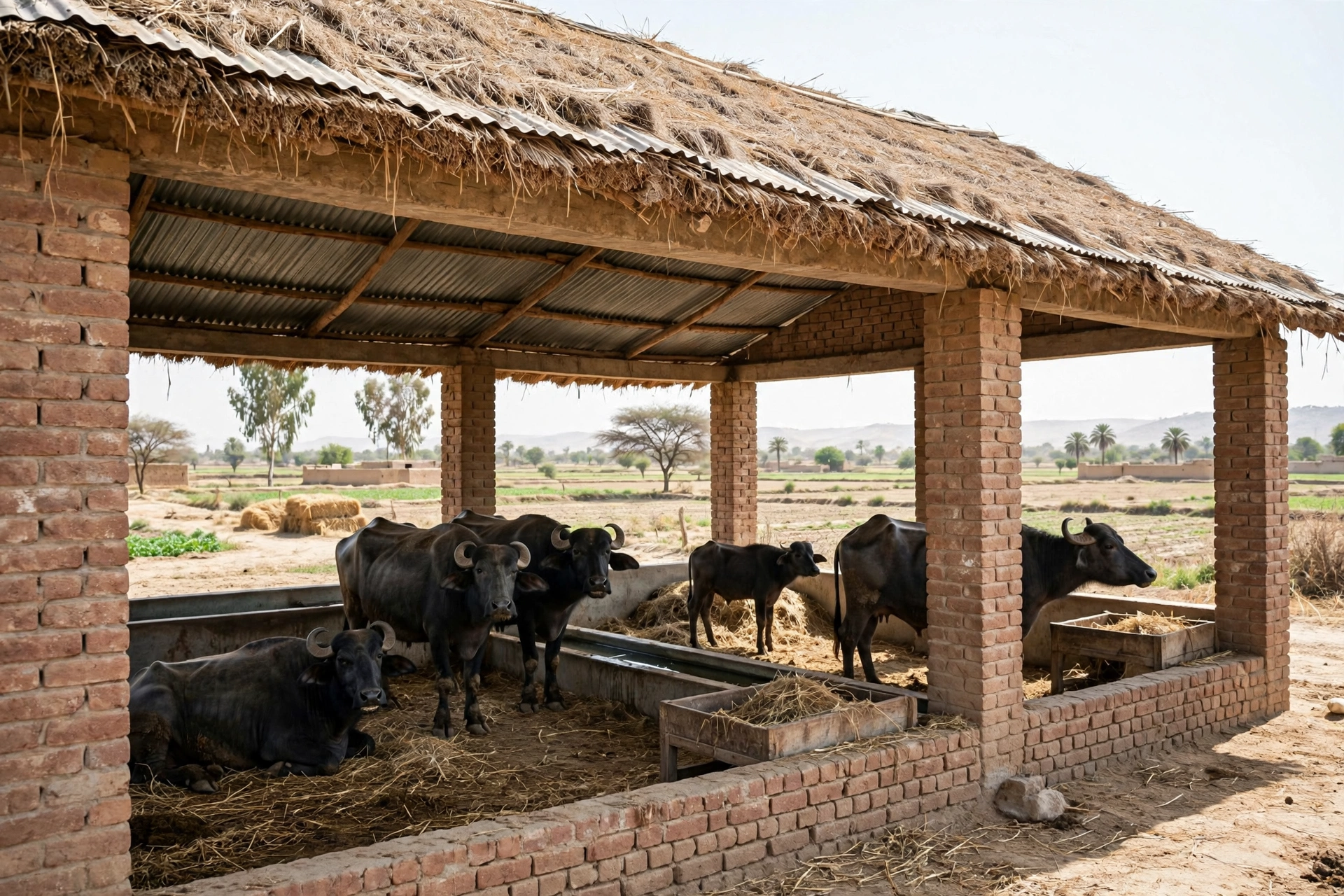
- Thatch (kacha roof): Excellent insulation and the coolest option, but needs replacement every couple of years and is a fire risk.
- RCC/concrete roof: Expensive, heavy, and actually holds heat. Not recommended for animal sheds in hot areas.
My practical recommendation for most farmers: asbestos sheets on a high frame, with the top painted white and a 2–3 foot gap between the roof and the top of the walls for air to escape. That ridge gap is one of the cheapest cooling features you can build.
Space Per Animal: The Numbers
Crowding is a silent profit-killer. Overcrowded animals lie in each other’s heat, compete at the feed trough, and spread disease faster. Here are the minimums I recommend:
- Covered shed area: 40–50 square feet per adult buffalo (roughly 8 × 5 feet). For ten buffaloes, that is 400–500 square feet of covered space minimum — though I always advise building a little bigger than minimum, because herds grow.
- Open paddock: Another 80–100 square feet per animal of open, unroofed area where animals can move, and where you can feed during pleasant weather.
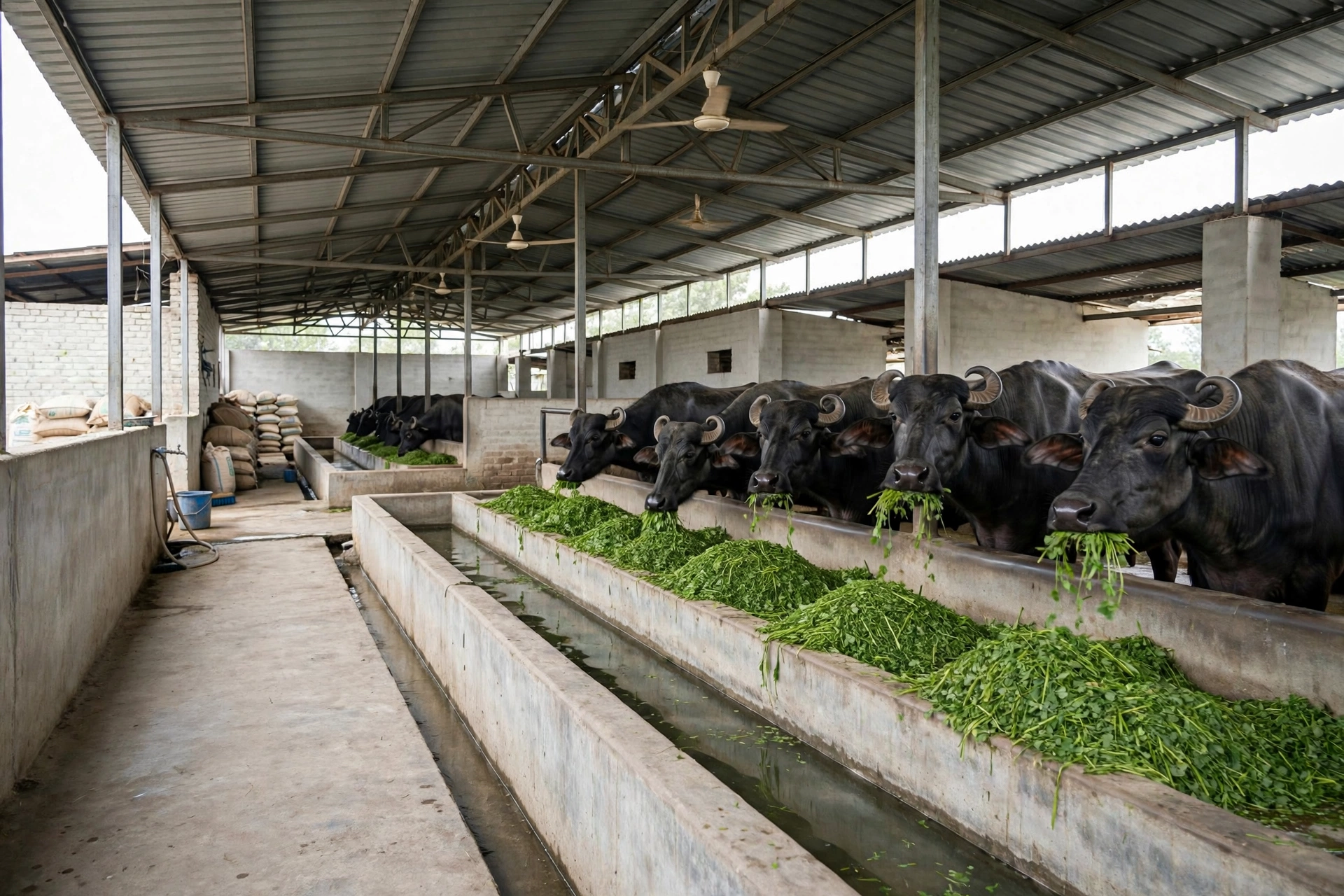
- Feeding space: At least 2–2.5 feet of manger length per animal. If ten buffaloes share a 10-foot trough, the timid ones will not eat enough. This is one of the most common and most fixable mistakes I see.
Calves need separate space — about 15–20 square feet per calf in a draft-free corner. Never house calves in the same airspace as adult animals if you can avoid it; it is how pneumonia spreads.
Flooring: Brick vs Concrete vs Sand Bedding
The floor is where your animals spend 12–14 hours a day lying down. It matters more than most farmers think.
Concrete is durable and easy to clean, but it is hard on joints and slippery when wet. If you use concrete, it must have a rough finish (broomed, not smooth) and a proper slope — about 1–2% gradient toward the drain. Smooth concrete plus a 500-kg buffalo is an injury waiting to happen.
Brick-on-edge is my usual recommendation. It provides grip, drains reasonably, is comfortable enough for lying, and is cheap to repair — you replace individual bricks instead of recasting a slab. Lay the bricks on edge (not flat) with sand joints, on a well-compacted base.
Sand bedding over a concrete or earth base is the most comfortable option and increasingly popular. A 4–6 inch layer of clean, dry sand gives excellent comfort and hoof health. The catch: you must top it up regularly and remove soiled sand, or it becomes a bacterial soup. It works well if you are disciplined about maintenance.
Whatever you choose, the floor must slope to a drain. Standing urine and slurry is the root cause of most hoof problems and a major contributor to mastitis. I cannot count the number of mastitis cases I have treated where the real prescription was “fix your drainage.”
Ventilation and Cooling
In our climate, the goal is simple: keep air moving and give heat somewhere to go.
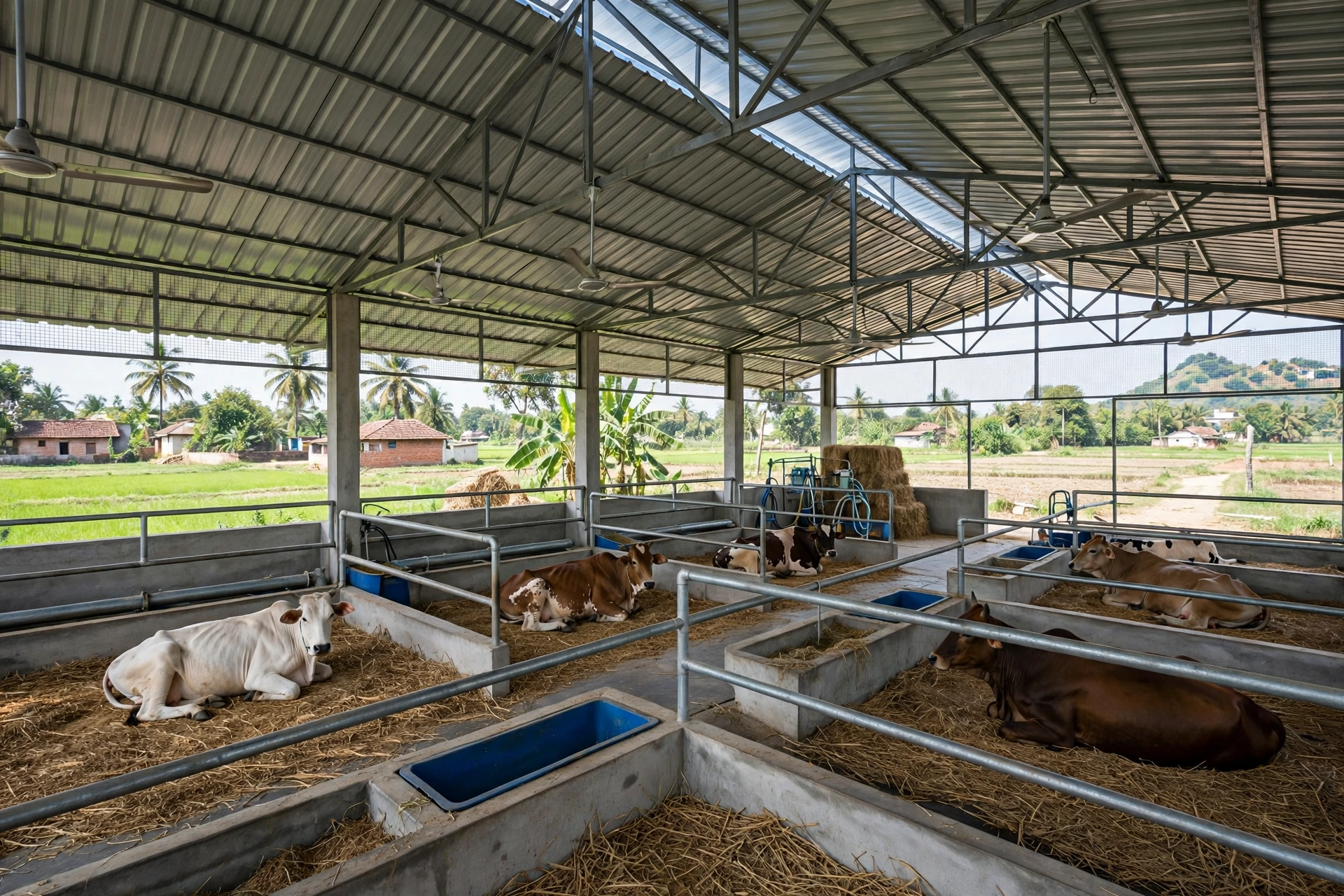
Natural ventilation should do most of the work. Open sides (at least on two sides), the ridge gap I mentioned, and no solid walls above 3–4 feet on the sides. Solid walls turn a shed into a box; half-walls with open space above let breezes through while still blocking driving rain.
Fans are the single best investment for summer. Large, slow ceiling or wall-mounted fans that keep air moving over the animals reduce heat stress dramatically. For a ten-buffalo shed, two to three good fans are usually enough. Run them from late morning through evening in summer. The electricity cost is small compared to the milk you protect.
Water sprinkling works brilliantly for buffaloes — they love water. A simple overhead sprinkler line, or even manual sprinkling with a hose twice a day (late morning and mid-afternoon), cools animals fast through evaporation. The key rule: sprinkle, then let the animal dry in moving air. Wet animals in still air just get humid.
Foggers/misters are a step up — fine mist nozzles along the shed that cool the air itself. They work well in dry heat (May–June) but are less effective in humid monsoon months when the air is already saturated. If you install them, use them with fans, not instead of fans.
Wallowing ponds for buffaloes deserve special mention. Nothing cools a buffalo like a wallow. If you have the space and water, even a simple shallow pond (3–4 feet deep) in the paddock will be used daily in summer. Buffaloes that wallow regularly show visibly better summer milk persistence. Just keep the water reasonably clean — stagnant, filthy wallows spread skin infections and parasites.
Feeding and Watering in the Shed
Place water troughs in the shade, never in direct sun — buffaloes drink noticeably less from hot, sun-warmed water. In summer, an adult buffalo needs 60–80 litres of water a day; in peak heat, even more. Two troughs for ten animals, cleaned regularly.
Feed during the cool hours. In summer, offer the major concentrate feed early morning and late evening, not at noon when animals are too hot to eat. This one scheduling change alone can recover feed intake that heat would otherwise steal.
Drainage and Manure Handling
Plan your manure flow the way you plan your milk flow. Each adult buffalo produces 12–15 kg of dung daily — ten animals means over a quintal a day. Without a system, it piles up around the shed, breeds flies, and contaminates feed and water.
The practical setup: a sloped concrete apron behind the shed leading to a manure pit or compost area at least 30–40 feet from the shed (downwind if possible). Scrape or wash the shed floor daily — this takes 20 minutes and prevents 80% of hygiene problems. Composted manure is valuable; many farmers sell it or use it on their fodder fields, turning a waste problem into an input.
Low-Cost Improvements for Existing Sheds
Not everyone can rebuild. If your shed already exists and has problems, here is what to do, cheapest first:
- Paint the roof white or lay reflective sheeting on top. Costs little, drops the temperature under the roof noticeably.
- Open up the sides. Remove solid wall sections above 3 feet and replace with nothing — just open air, or bamboo matting you can roll up in winter.
- Add fans. Even one fan changes the air in a small shed.
- Extend the roof overhang with cheap sheeting to shade the walls and the area in front of the shed.
- Fix the slope. If water pools, break and relay just the worst sections with proper gradient to a drain.
- Plant trees on the west side of the shed. A row of fast-growing trees gives afternoon shade within two to three years and costs almost nothing.
Frequently Asked Questions
Is an open shed better than a closed shed in hot climates? For our region, yes — an open-sided shed with a high roof almost always outperforms a closed building. Closed sheds trap heat and ammonia. The only reason to close sides is winter cold or driving monsoon rain, and removable curtains or bamboo screens handle that better than permanent walls.
How do I keep the shed warm enough in winter then? Winter needs are modest in most of Punjab and Sindh. Close the windward side with removable tarpaulin or bamboo mats on cold nights, provide dry bedding, and the animals’ own body heat does the rest. Adult buffaloes handle our winters well; it is calves that need the extra protection.
What is the cheapest flooring I can start with? Well-compacted earth with a sand layer, properly sloped. It costs almost nothing and is comfortable. The downside is maintenance — you will re-level it regularly. Upgrade to brick-on-edge when cash flow allows.
Should the milking area be separate? If you can manage it, yes — even a simple clean corner with a concrete platform. Milking in the same dirty standing area where animals dung invites mastitis. Clean milking conditions are one of the cheapest ways to protect udder health.
Final Word
You do not need an expensive shed. You need a high roof, moving air, dry footing, clean water, and enough space. I have seen ten-buffalo farms in simple open sheds outperform farms in costly buildings, simply because the simple shed breathed and the expensive one baked. Build for the climate you have, not the farm you saw in a photograph from another country. Your buffaloes will tell you whether you got it right — in litres, every single morning.
Disclaimer: This article is for educational purposes only and reflects general field experience. Construction costs and material availability vary by region. For animal health concerns related to housing, please consult your local veterinarian.